
Why Subscriptions Don't Work for Survey Tools
The uncomfortable truth
Subscription pricing is a great business model — for businesses.
It produces predictable revenue and rewards companies when customers keep paying over time. Even Stripe’s own documentation frames subscriptions as recurring fees for ongoing access.
But when you apply that model to surveys, something breaks.
Surveys aren’t like accounting software, email, chat, or project management — where value is created continuously, every week.
Surveys are typically event-driven:
- Launch a customer feedback pulse after a release
- Run a staff survey once a quarter
- Collect event feedback for 10 days
- Validate an idea before spending money building it
You don’t “use surveys monthly” by default.
That mismatch is the core problem.
1) Surveys are bursty; subscriptions assume steady usage
A subscription assumes the customer receives steady value each billing cycle.
Survey usage is usually:
- High activity for a short window
- Followed by weeks or months of zero activity
So what happens?
You pay for months you don’t use… because you might need it again later.
Even Typeform’s pricing page describes response limits as monthly, resetting every cycle. That reset may fit continuous lead-gen programs, but it’s a poor fit for “one survey this month, none for the next three.”
The result: people don’t feel like they’re paying for outcomes — they feel like they’re paying for permission.
2) Subscriptions create paywalls at the worst moment
Here’s the typical survey journey:
- You invest time writing questions
- You polish the survey
- You get stakeholder buy-in
- You’re ready to send it
Then: Publish is locked behind a plan.
This is the highest-intent moment — you’re already committed — and it’s when pricing friction hits hardest.
That friction is not just emotional. It’s operational:
- You may need a purchase approval
- You may not know if the survey will even work
- You may be doing this for a one-off use case
Subscription gating at publish isn’t accidentally effective — it’s a conversion tactic. But it’s also a trust leak for the exact audience that runs surveys occasionally.
3) Subscriptions monetize forgetting, not value
There’s well-documented evidence showing subscription businesses can earn dramatically more than they would if customers paid close attention to every ongoing charge — because many people don’t cancel even when value drops.
That dynamic can exist in any subscription category, but survey tools are especially prone to it because:
- Projects end
- The person who started the subscription changes roles
- Teams forget which card is on file
- “We’ll cancel later” becomes “we forgot”
If your pricing model is strongest when customers are inattentive, you’re not aligned with customer success — you’re aligned with customer inertia.
That’s not “evil,” it’s just incentives. But it’s a reason many users increasingly dislike subscriptions for occasional-use tools.
4) Response caps + subscriptions is the worst of both worlds
If a product charges monthly, customers expect generous or unlimited usage. But many survey tools combine:
- Monthly or annual subscription and
- Response limits or tier constraints
Typeform’s pricing emphasizes response caps by plan — 100, 1,000, or 10,000 per month depending on tier.
SurveyMonkey’s pricing shows similar patterns — plan-based response limits with policies for overages.
This is why users get frustrated:
- “I’m paying every month… why am I still capped?”
- “Why is my cost based on time and also volume?”
From a customer’s perspective, it feels like paying twice.
5) Subscriptions punish experimentation (which surveys depend on)
Good surveys often require iteration:
- You test question wording
- You learn that respondents drop off
- You simplify, re-run, compare
Subscriptions discourage this for occasional users because:
- Starting “just to test” feels expensive
- The monthly clock adds pressure
- People delay learning because payment feels premature
That’s backward.
The entire value of surveys is learning faster — pricing should help that, not slow it down.
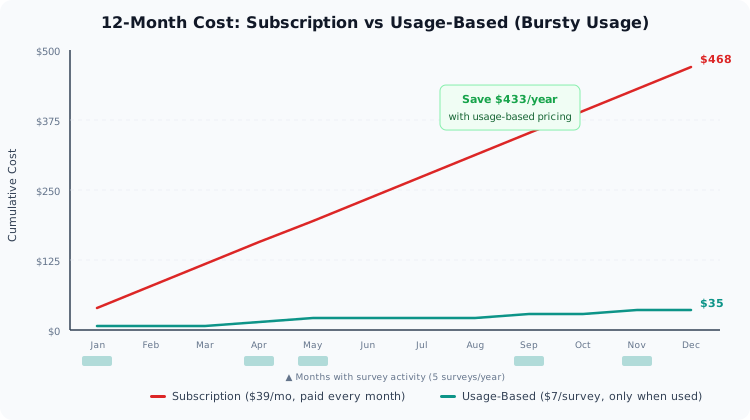
When subscriptions do work for surveys
To be fair: subscriptions can be a perfect match if surveys are truly continuous.
Subscriptions make sense when you have:
- Always-on lead capture forms
- Weekly research and experimentation
- A large team running many surveys continuously
- Deep compliance requirements, SSO, enterprise workflows
In other words: subscriptions work when survey activity is steady and predictable.
But that’s not the majority of people who want “a simple survey tool.”
What pricing model fits surveys better?
The pricing model that matches survey behavior is usage-based (pay-as-you-go):
- Pay when you publish
- Pay based on responses collected
- Don’t pay when you’re not collecting
This aligns cost with value:
- No value without responses
- More value with more responses
- No billing while idle
It also reduces the most common emotional objections:
- “I only need this once.”
- “I don’t want another monthly bill.”
- “I’m not sure yet.”
There’s a broader shift happening in SaaS where usage-based pricing is gaining popularity specifically because it lowers entry barriers and aligns pricing to value.
That alignment is exactly what survey users want.
How we approach this at SurveyReflex
We built SurveyReflex around a simple principle:
You should be able to create surveys freely, and only pay when you’re ready to collect responses.
- Build surveys (drafts) without paying
- Publish when ready
- Choose a response tier based on your needs
- Pay only for that survey’s responses
No monthly plan required.
This isn’t “anti-subscription.” It’s just a better fit for how surveys are actually used — and it’s the model we’d want if we were on the other side of the pricing page.
Try it the way surveys should work
If you’re tired of subscription gating and monthly limits for one-off surveys:
- Create a survey for free on SurveyReflex
- Publish only when you’re ready
- Pay only for the responses you need
Coming up next: How response-based pricing changes product decisions — and why most tools avoid it.
— The SurveyReflex Team