
Why Most Surveys Fail (And What Actually Makes People Finish Them)
The uncomfortable reality
Most people overestimate how effective their surveys are.
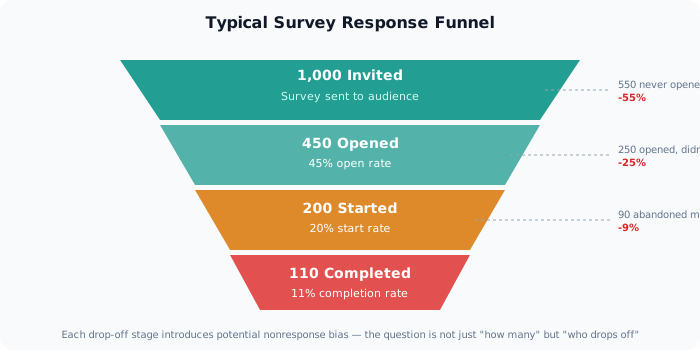
You send a survey to 1,000 people. You get 150 responses. Only 110 finish it.
You call it “good enough.”
But in survey research, that’s a 15% response rate and an even lower completion rate — which raises serious concerns about data reliability and nonresponse bias.
According to the Pew Research Center, response rates in telephone surveys have dropped dramatically over the past decades — from ~36% in the late 1990s to single digits in many modern surveys. While online surveys operate differently, the broader trend is clear: people are increasingly less willing to participate in surveys.
The problem isn’t just fewer responses. It’s who finishes and who drops off.
And that’s where most surveys quietly fail.
1. Survey fatigue is real — and measurable
The term survey fatigue is widely discussed in academic and market research literature. As surveys have become more common in email, apps, customer support, and product workflows, participation willingness has declined.
Research published in Public Opinion Quarterly shows that participation burden significantly impacts response rates and completion. Longer surveys correlate with higher dropout rates and increased satisficing (rushing through answers without careful thought).
What this means in practice:
- People are more selective about which surveys they complete.
- If your survey looks long or cognitively heavy, many will exit early.
- Those who remain may rush.
Completion isn’t just about “length.” It’s about perceived effort.
2. Length is the #1 silent killer
Multiple industry studies (including Qualtrics and SurveyMonkey research summaries) show a consistent pattern:
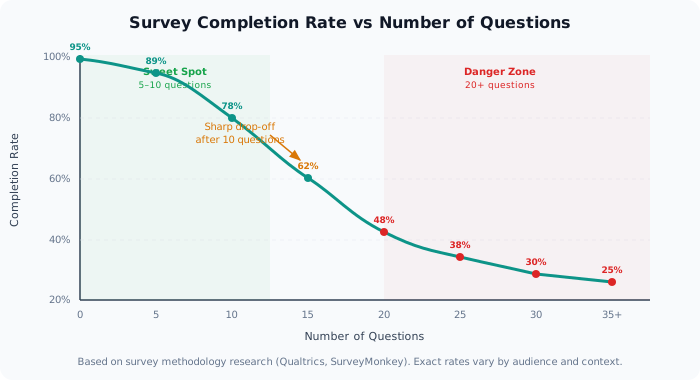
- Completion rates drop significantly after 7–10 minutes.
- Drop-off increases sharply after 20+ questions.
- Open-ended questions increase abandonment rates more than multiple choice.
Qualtrics Research suggests that survey completion rates decline as survey length increases, especially in mobile environments.
This aligns with cognitive load theory:
The more mental effort required, the more likely a person disengages.
Most survey creators underestimate:
- How long questions actually take to answer
- How exhausting open-ended responses feel
- How quickly attention declines
If your survey “only takes 10 minutes,” that often means:
- 3–4 minutes for highly motivated respondents
- 12–15 minutes for average participants
- Instant exit for busy people
And busy people are often your most valuable respondents.
3. Nonresponse bias is more dangerous than low response rate
Low response rates are not automatically fatal.
But systematic nonresponse is.
Pew Research emphasizes that declining response rates alone don’t invalidate surveys — but bias increases when certain types of people consistently drop out or never respond.
If:
- Younger users drop off early
- Busy professionals exit midway
- Only highly opinionated respondents finish
Then your data becomes skewed.
The scary part?
Most survey creators never measure:
- Where respondents drop off
- Which questions trigger abandonment
- Whether certain demographics exit earlier
They just look at “total responses.”
4. Open-ended questions dramatically increase dropout
Open-ended questions feel insightful.
But they are cognitively expensive.
Research in survey methodology consistently shows:
- Open-ended responses take significantly more time
- They increase abandonment
- They produce higher item nonresponse (skipped questions)
Why?
Because open-text requires:
- Memory recall
- Language construction
- Emotional processing
- Typing effort (especially on mobile)
That’s friction.
And friction kills completion.
5. Mobile experience changes everything
Today, a large portion of surveys are completed on mobile devices.
Mobile respondents:
- Have shorter attention spans
- Are more sensitive to layout clutter
- Are less willing to scroll through long pages
- Dislike typing long text
If your survey is not optimized for mobile:
- Drop-off increases
- Data quality declines
- Partial responses increase
Mobile doesn’t just change screen size.
It changes tolerance.
6. People quit when surveys feel pointless
This is rarely discussed.
Participants ask subconsciously:
- Why am I doing this?
- Does this matter?
- Will anything change?
- Is this anonymous?
- How long will this take?
If those answers aren’t clear, motivation drops.
Behavioral research shows that perceived purpose increases task completion. Humans are more willing to invest effort when outcomes are meaningful.
When surveys feel transactional or endless, people disengage.
What Actually Makes People Finish Surveys
Now the practical part.
Here’s what research and behavioral science consistently support.
1. Reduce visible complexity
One-question-at-a-time formats reduce perceived effort.
Even if total question count stays the same, breaking them into digestible screens lowers cognitive overload.
This aligns with cognitive load theory and progressive disclosure principles in UX design.
2. Show honest progress indicators
Progress bars increase completion when:
- They move consistently
- They don’t stall at 90%
- They reflect true progress
Research in human-computer interaction shows that visible progress reduces uncertainty and increases persistence.
3. Estimate time realistically
Instead of:
“This will only take 5 minutes!”
Use:
“Approximately 3–5 minutes.”
Underpromising builds trust.
Overpromising destroys it.
4. Minimize open-ended questions
Use them sparingly:
- For insight, not filler
- At the end, not the beginning
- Only when essential
Replace: “What are your thoughts?”
With: “Which of the following best describes your experience?“
5. Design for mobile first
- Large touch targets
- Minimal scrolling
- Clear contrast
- No dense question clusters
Mobile-first design improves completion and data quality.
6. Close the feedback loop
Tell respondents:
- Why their input matters
- What you’ll do with it
- When they’ll see results
This increases perceived impact and future participation.
The hard truth
Most surveys fail not because people don’t care.
They fail because:
- They are too long.
- They demand too much effort.
- They hide time expectations.
- They ignore mobile behavior.
- They don’t respect respondent attention.
Completion rate isn’t luck.
It’s design.
What this means for SurveyReflex
SurveyReflex is intentionally built around:
- One-question display mode for engagement
- Mobile-first survey rendering
- Clear progress indicators
- Clean UI without clutter
- Focused response tiers (encouraging shorter, sharper surveys)
The goal isn’t to collect more responses.
It’s to collect better, more complete responses.
Before You Launch Your Next Survey
Try this experiment:
- Cut 30% of your questions.
- Remove at least one open-ended field.
- Add a realistic time estimate.
- Preview it on mobile.
You’ll likely see higher completion.
If you want a clean, distraction-free builder to test it, start a draft on SurveyReflex — drafts are always free.
Next week: The hidden cost of bad survey data — and how poor design quietly destroys decision-making.
— The SurveyReflex Team