
When Is Your Sample Size Actually Enough?
One of the most common questions teams ask after running a survey is:
“How many responses do we need before we can trust this?”
The answers are usually simplistic:
- “At least 100.”
- “We need 500 to be safe.”
- “The more, the better.”
Those answers sound responsible. They are also incomplete.
Sample size is not just a number. It is a relationship between:
- The population you’re studying
- The margin of error you’re willing to tolerate
- The variability in responses
- The decision you plan to make
Understanding this changes how you design surveys — and how you interpret them.
Bigger is not always better
Many teams assume that doubling sample size doubles confidence.
It doesn’t.
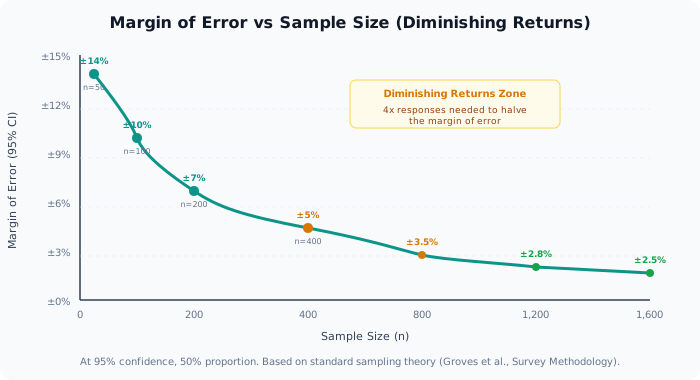
Statistically, the margin of error decreases with the square root of the sample size — not linearly. That means gains diminish as you collect more responses.
For example:
At 100 responses, margin of error (for a 50% proportion at 95% confidence) is about ±10%. At 400 responses, it drops to about ±5%. At 1,600 responses, it drops to about ±2.5%.
Notice what happens: You need 4x the responses to cut margin of error in half.
This relationship is fundamental to sampling theory and is widely documented in survey methodology literature (see Groves et al., Survey Methodology).
The practical implication: Going from 100 to 200 responses does not dramatically change certainty. Going from 400 to 1,000 may not meaningfully change your decision.
Population size often matters less than you think
Another misconception:
“If we have 50,000 users, we need thousands of responses.”
Not necessarily.
For large populations, required sample size stabilizes quickly.
Whether your population is:
- 20,000
- 200,000
- 2 million
The sample size required to estimate proportions with a given margin of error is surprisingly similar once the population is large.
Pew Research explains this clearly in their methods overview — sample size requirements depend far more on desired precision than on total population size.
The key determinant is how precise you want your estimate to be — not how many users exist.
Margin of error is about proportions, not individual truth
When you see:
“60% of users prefer Feature A.”
With a ±5% margin of error, that really means: The true population proportion likely lies between 55% and 65%.
This uncertainty is often ignored in business presentations.
But here’s the deeper insight:
If you’re deciding between: Feature A (60%) Feature B (40%)
Even with ±5% error, the conclusion likely holds.
But if your survey shows: Feature A (52%) Feature B (48%)
Even a large sample may not justify a confident decision.
Sample size cannot rescue ambiguous distributions.
The hidden factor: variability
Sample size requirements depend on variability.
If responses are tightly clustered:
- Clear preference
- Strong majority
You need fewer responses to detect a meaningful pattern.
If responses are evenly split:
- High variance
- Small differences
You need many more responses to confidently distinguish options.
This is why some surveys “feel decisive” with 80 responses — and others remain ambiguous at 500.
It’s not just count. It’s spread.
The overlooked variable: bias
This is where most teams go wrong.
Sample size calculations assume:
- Random sampling
- Representative respondents
But if your survey suffers from nonresponse bias (discussed previously), increasing sample size does not fix the problem.
You can collect 2,000 biased responses and still be wrong.
Groves (2006) makes this explicit: bias and variance are separate components of survey error. Increasing sample size reduces variance — but not bias.
This is one of the most misunderstood truths in survey research.
More responses reduce noise. They do not fix skew.
Decision context matters more than arbitrary thresholds
Instead of asking:
“How many responses do we need?”
Ask:
“What decision are we making?”
If you are:
- Choosing between two clearly separated options → moderate sample may suffice.
- Validating minor UX wording → smaller samples can detect obvious confusion.
- Setting pricing strategy → larger, more representative sample required.
- Measuring satisfaction trend over time → consistency matters more than size.
The cost of being wrong should influence your tolerance for uncertainty.
In high-risk decisions:
- Larger sample
- Better representativeness
- Cross-validation recommended.
In low-risk iteration:
- Smaller, directional sample may be sufficient.
The illusion of round numbers
Many organizations default to: “Let’s wait until we hit 100.”
This number is psychologically satisfying — not statistically magical.
A survey with: 97 responses is not fundamentally weaker than one with: 103 responses.
Precision improves gradually — not at milestone thresholds.
When 50 responses might be enough
If:
- Population is relatively homogeneous
- Differences between options are large
- Survey is tightly designed
- Decision risk is moderate
50–75 thoughtful, representative responses can be directionally valuable.
In usability research, small sample testing (5–20 participants) is often sufficient to uncover major usability problems (Nielsen Norman Group has repeatedly demonstrated this principle in usability testing contexts).
Small samples are not universally weak. They are weak only when used for the wrong purpose.
When 500 responses still aren’t enough
If:
- The survey has strong nonresponse bias
- The question wording is flawed
- The distribution is nearly split
- The sample overrepresents one segment
Large sample size gives you: More precision about a distorted estimate.
That can be more dangerous than a small, uncertain sample.
A practical framework for “enough”
Before deciding your sample is sufficient, evaluate:
- Is the sample reasonably representative?
- Are key segments adequately included?
- Is margin of error acceptable for the decision?
- Are differences between options meaningfully larger than the error band?
- Does increasing the sample materially change the conclusion?
If collecting 200 more responses would not change your decision — you likely have enough.
If small shifts in percentage would reverse your decision — you likely do not.
The real insight
Sample size is not about achieving a socially acceptable number.
It is about achieving decision confidence relative to:
- Risk
- Variability
- Bias
- Precision
More data feels safer.
But intelligent data is safer.
A practical experiment
Before your next survey, define in advance:
- What difference would change your decision?
- What margin of uncertainty are you comfortable with?
- Which segments must be represented?
Then stop collecting data when additional responses stop changing the conclusion.
That is what “enough” actually means.
References
- Groves, R. M. (2006). Nonresponse Rates and Nonresponse Bias in Household Surveys. Public Opinion Quarterly.
- Pew Research Center. Survey Methods Overview.
- AAPOR. Survey Research Methods and Quality Considerations.
— The SurveyReflex Team