
How to Design a Customer Satisfaction Survey (Backed by Research)
Customer satisfaction surveys are among the most widely used tools for understanding how audiences feel about your product, service, or brand. But poorly designed surveys lead to misleading insights, biased results, and bad decisions.
High-quality survey design requires more than templates — it requires an understanding of question types, sequence, bias, and respondent effort. This blog provides a research-backed framework for designing customer satisfaction surveys that produce meaningful and reliable data.
What does “customer satisfaction” mean — and why it matters
Customer satisfaction describes the degree to which customers feel their expectations were met or exceeded by your product or service. It is typically used to assess:
- brand loyalty
- product experience
- service quality
- likelihood of repeat purchase
Reliable measurement requires both quantitative and qualitative data. Quantitative questions help you measure how much; qualitative questions help you understand why.
Start with clear objectives
Before writing a single question, define what you want to learn from your survey. Ask yourself:
- Are we measuring overall satisfaction?
- Are we trying to identify drivers of satisfaction?
- Are we comparing satisfaction across segments?
This focus will determine which question types you use.
Survey research theory emphasizes that questionnaires should be built with clear conceptual frameworks — purpose, measurement targets, and analysis plans — before question writing begins.
A proven question-type mix
Good surveys mix multiple question types to balance ease of response with depth of insight. SurveyReflex supports 19 question types spanning choice, text, rating, date, contact, matrix, and display blocks.
Below are recommended question types for customer satisfaction surveys, mapped to research goals.
1) Warm-up: Collect basic customer context
Multiple Choice Questions (Choice category)
Purpose: classify respondents into meaningful groups (e.g., purchase type, product line, etc.). Multiple choice questions are closed-ended and allow easy segmentation of responses.
Example:
Which of the following best describes your primary use of our product?
- Daily
- Weekly
- Monthly
- Rarely
Rationale: Respondents can answer quickly, and the data is easy to quantify.
2) Core satisfaction metrics
Rating Scale / Likert Scale Questions (Rating category)
Rating and Likert scales capture degree of satisfaction, agreement, or frequency. They produce data that is both quantifiable and sensitive to nuance.
Example (5-point scale):
How satisfied are you with your overall experience? 1 – Very dissatisfied 2 – Dissatisfied 3 – Neither satisfied nor dissatisfied 4 – Satisfied 5 – Very satisfied
Use consistent scales throughout to reduce cognitive effort.
Tip: If you include scales like “agree/disagree,” use balanced options to avoid acquiescence bias, where respondents may disproportionately agree simply because of scale design.
3) Probe deeper into drivers of satisfaction
Matrix Questions (Matrix category)
Matrix questions allow respondents to rate several related items on the same scale. Efficient for evaluating multiple aspects like usability, support quality, and feature usefulness.
Example:
Please rate the following aspects of our service:
| Feature | Very Poor | Poor | Neutral | Good | Very Good |
|---|---|---|---|---|---|
| Product performance | ⃝ | ⃝ | ⃝ | ⃝ | ⃝ |
| Responsiveness of support | ⃝ | ⃝ | ⃝ | ⃝ | ⃝ |
| Ease of use | ⃝ | ⃝ | ⃝ | ⃝ | ⃝ |
Matrix formats reduce survey length while increasing depth.
4) Understand underlying decisions
Dropdown / Single Select Questions (Choice category)
When there are many response options (such as product variants or locations), dropdowns minimize clutter and keep the survey clean.
Example:
Which product line did you purchase? (Select from dropdown list)
Use this when you need participants to choose from longer lists without overwhelming the interface.
5) Capture voice and nuance
Open-Ended Questions (Text category)
Open-ended questions let respondents express thoughts in their own words. These generate qualitative insights that numbers alone cannot.
Example:
What could we do to improve your experience?
Best practice: place open-ended questions after quantitative ones — respondents can reflect based on how they answered earlier.
6) Closing questions
Contact / Demographic Questions (Contact category)
These gather additional context that can be useful for segmentation but should be optional to avoid drop-offs.
Example:
(Optional) Please provide your email if you’d like a follow-up.
Sequence and cognitive effort
Survey methodology research strongly suggests placing easier questions at the beginning and grouping similar types together. This reduces cognitive load and survey abandonment.
A good satisfaction survey should take no more than 5 minutes, which typically translates to ~8–12 well-chosen questions.
Avoiding common pitfalls
Leading questions
Avoid framing that pushes respondents in a direction. For example:
“How great was your experience?” This suggests a positive answer. Write neutral language instead.
Response bias
Acquiescence and courtesy biases can distort satisfaction results if scales are unbalanced or phrasing is social.
Order effects
The order of questions can influence later answers. Put demographic/context questions after core satisfaction metrics to avoid early distraction.
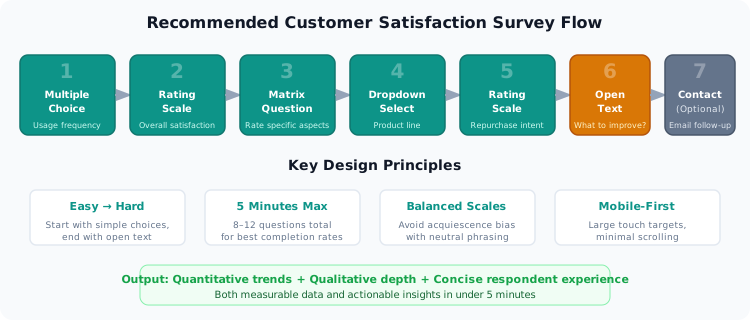
Putting it all together — Example Survey Flow
Here’s a recommended sequence using SurveyReflex question types:
- Multiple Choice – Frequency of product use
- Rating Scale – Overall satisfaction
- Matrix Question – Satisfaction with specific aspects
- Dropdown – Product line
- Rating Scale – Likelihood to repurchase
- Open-Ended – What would you improve?
- Contact (optional) – Email for follow-up
This balance yields:
- Quantitative measurement for trends
- Qualitative insight for depth
- A concise, engaging respondent experience
Testing and analyzing results
Before launching:
- Pilot the survey with a small group
- Look for ambiguous responses or high drop-off points
- Adjust question wording or sequencing
Once collected:
- Analyze quantitative scores for patterns
- Use open-ended responses to explain trends
- Map satisfaction drivers to business actions
Final thoughts
Designing a high-quality customer satisfaction survey is both an art and a science. It requires:
- A clear objective
- Knowledge of question types
- Attention to bias and sequence
- Alignment between data needed and respondent effort
Using the right mix of question types supported by SurveyReflex — choice, rating, matrix, dropdown, and open-ended — you can build surveys that are both efficient to answer and rich in insight.
References
- Survey question types and best practices (SurveyReflex)
- Survey question types and how to use them (SurveyMonkey)
- How to design good questionnaire items (PMC/NIH)
- Open vs closed-ended questions and insights (Zonka Feedback)
- Short and engaging surveys increase completion (EmbedSocial)
— The SurveyReflex Team