
The Hidden Cost of Bad Survey Data (And Why Most Teams Don't Notice It)
Most teams treat surveys like a quick shortcut to certainty: ask a few questions, collect responses, chart the results, decide what to do next. It feels scientific. Numbers, percentages, even a few quotes. But the uncomfortable truth is that survey data can be “clean-looking” and still be misleading — and it’s often misleading in predictable ways.
This isn’t about people being dishonest. It’s about how humans behave when they’re busy, how different kinds of people opt in or drop out, and how small design choices change who answers and how carefully they answer. Survey researchers have studied these issues for decades, and the patterns are consistent across methods: response rates vary by group, nonresponse can bias estimates, and “good enough” answering (satisficing) is common when effort is high.
The real cost isn’t “we didn’t get enough responses.” The real cost is false confidence — decisions that look justified because they’re backed by charts, but are quietly built on skewed input.
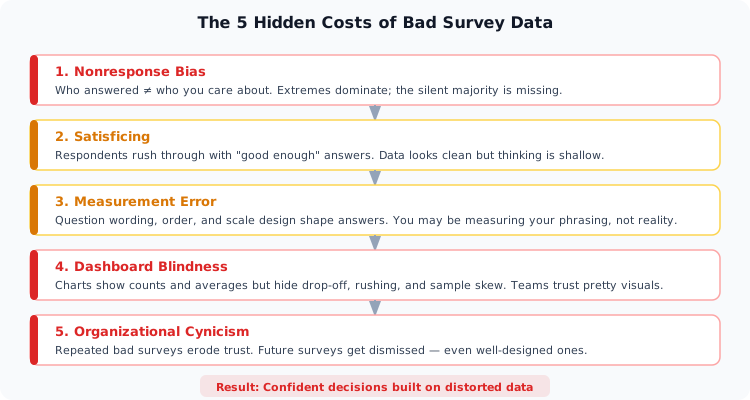
Bad survey data is expensive because it creates confident decisions, not uncertainty
If you run a flawed survey and get no responses, you know it failed. That’s a visible failure.
The more dangerous scenario is when you get some responses — enough to make graphs look credible — but the data is systematically tilted. Pew Research has documented how modern surveys often face very low response rates and how researchers must work carefully to assess and reduce nonresponse bias. The key point for product and business teams: the “respondents” are not automatically representative of the population you care about.
In practical terms, biased survey data pushes teams to:
- prioritize the wrong features (“users want X”),
- misjudge customer satisfaction (“people love it”),
- misread churn drivers (“price is the problem”),
- and misallocate budgets (marketing, onboarding, support).
And because the outputs are numbers, the organization often treats them as objective truth.
The first hidden cost: nonresponse bias (who answers is the story)
Many teams focus on response rate as a vanity metric (“we got 200 responses!”). But survey methodology research has been clear on a subtle but important point: low response rates do not automatically mean high bias, and high response rates do not automatically mean low bias. What matters is whether the people who did not respond differ in meaningful ways from those who did. This relationship is discussed extensively in Groves’ foundational paper on nonresponse and nonresponse bias.
Here’s the eye-opener: two surveys can both have 20% response rates, but one can be far more biased depending on who that 20% is.
What does that look like in real life?
- Your most engaged users respond quickly.
- Your most unhappy users respond passionately.
- Busy, moderate, “silent majority” users often don’t respond at all.
- People who feel the survey won’t matter opt out early.
So the survey becomes a microphone for extremes, and your dashboard averages those extremes into something that looks stable and “balanced.” It isn’t.
This is why professional standards and government guidance emphasize assessing nonresponse bias rather than assuming response count equals accuracy. The U.S. Federal Committee on Statistical Methodology has a detailed best-practices report on nonresponse bias reporting that’s worth reading even if you’re not doing academic research — because it explains, in plain terms, why “who didn’t answer” can be the biggest threat to validity.
The second hidden cost: satisficing (answers that look valid but aren’t thoughtful)
Even when people do respond, many will not answer with full effort. Survey researchers call this satisficing: respondents give quick, “good enough” answers when the questions demand more attention or energy than they’re willing to spend.
This is not rare behavior; it’s a known mechanism behind issues like:
- straightlining in grids (same choice repeatedly),
- choosing middle options to finish faster,
- skipping open text,
- selecting the first acceptable option (“primacy effects”),
- giving inconsistent answers across similar questions.
A peer-reviewed open-access paper on satisficing shows how satisficing can distort measurement properties and inflate reliability/validity signals — meaning your survey can look statistically “fine” while still being contaminated by low-effort responding.
This is where teams get tricked: the dataset looks clean. No obvious garbage. But the thinking behind the answers is shallow. If your survey has long text questions, dense pages, confusing scales, or repetitive items, you are effectively increasing the “effort tax” — and satisficing becomes more likely.
The third hidden cost: measurement error (you might be measuring your wording, not reality)
A survey is not a direct window into what people believe. It’s a measurement instrument. Small changes in wording, order, and context can change the answers — sometimes dramatically.
This matters because teams often interpret survey results as if they were physical measurements (“80% prefer A”). In reality, the results might be:
- a reaction to your phrasing,
- influenced by what question came right before,
- shaped by scale design (1–5 vs 1–10),
- biased by what options you included or omitted.
Pew’s work on benchmark comparisons and bias reduction repeatedly underscores that improving survey accuracy is not just about collecting more data — it’s about method choices that reduce bias and measurement error.
The “hidden cost” here is that teams can spend weeks building the wrong solution because the survey measured the wrong thing with high confidence.
The fourth hidden cost: dashboards hide the failure modes
Most analytics dashboards summarize:
- counts,
- percent distributions,
- averages,
- top-line trends.
They rarely force you to confront:
- where people dropped off,
- how long it took them,
- whether a subset rushed,
- whether one question caused abandonment,
- whether a small subgroup dominated the sample.
That means a team can feel the survey is “data-driven” without ever seeing the quality warnings.
AAPOR (the American Association for Public Opinion Research) has multiple task force reports focused on evaluating survey quality and understanding nonresponse. These reports make a key point that is very relevant to product teams: quality is multi-dimensional. A single metric like response rate or sample size can’t represent it.
A practical takeaway: if your tooling doesn’t surface drop-off, effort signals, and sample composition, teams default to trusting the pretty charts.
The fifth hidden cost: bad data trains organizations to distrust research
Here’s the long-term damage most teams don’t see: repeated low-quality surveys don’t just create one bad decision — they create organizational cynicism.
People start saying:
- “Surveys are useless.”
- “Customers don’t know what they want.”
- “We asked last year and nothing helped.”
Sometimes that cynicism is justified — not because surveys are useless, but because the organization repeatedly ran low-quality instruments, got biased or low-effort data, and treated it as truth.
Once stakeholders lose trust, even a well-designed survey later gets dismissed.
What to do instead (without turning surveys into a PhD project)
You don’t need perfect methodology to dramatically reduce risk. You need to design with the known failure modes in mind:
-
Treat representativeness as a question, not an assumption. Ask: Who is likely to answer this? Who is likely to ignore it? If busy users matter, design for them.
-
Reduce effort to reduce satisficing. Shorten the survey. Remove repetition. Use simple scales. Minimize grids. Put open-text at the end, sparingly.
-
Make the survey’s purpose obvious. People answer better when they understand why you’re asking and what will happen with the results.
-
Measure quality signals, not just outcomes. Track drop-off by question, completion time distribution, and patterns like straightlining.
-
Prefer fewer, sharper questions over “cover everything.” In survey work, breadth often trades off against attention and accuracy.
These aren’t “best practices” because they sound nice — they are direct countermeasures to known, documented mechanisms that harm survey validity.
A simple, practical CTA
If you run surveys today, try this one-week experiment:
- Take your last survey and cut 30% of the questions.
- Replace at least one open-text question with a structured multiple choice.
- Add a short purpose statement at the top (“We’re using this to decide X by date Y.”).
- Review drop-off and completion time, not just response counts.
If you want a clean place to draft and test survey flow before you send it, create a draft in SurveyReflex and run a small internal pilot first.
References
- Groves, R. M. (2006). Nonresponse Rates and Nonresponse Bias in Household Surveys (Public Opinion Quarterly)
- Pew Research Center (2017). What Low Response Rates Mean for Telephone Surveys
- Pew Research Center (2018). Reducing bias on benchmarks
- AAPOR (2016). Reassessing Survey Methods in the Digital Age
- AAPOR (2013). Report of the AAPOR Task Force on Non-Probability Sampling
- Federal Committee on Statistical Methodology (2023). Best Practices for Nonresponse Bias Reporting
- Hamby, T. (2016). Survey Satisficing Inflates Reliability and Validity Measures (open access, PMC/NIH)
— The SurveyReflex Team