
How to Design an Event Feedback Survey That Actually Improves Your Next Event
Running a great event is hard. Knowing whether you actually ran a great event is harder.
Most organizers rely on gut feelings, attendance numbers, and a handful of unsolicited comments. But attendance tells you who showed up — not whether it was worth their time. And the loudest feedback comes from extremes: people who loved it or hated it. The silent middle — the majority of your audience — disappears without a trace.
Post-event surveys fix this. When designed well, they capture structured, actionable data across the dimensions that actually matter: content quality, speaker performance, networking, logistics, and perceived value. When designed poorly, they become another ignored email in a crowded inbox.
This guide covers the research behind effective event feedback surveys — optimal timing, question design, NPS benchmarks for events, response rate strategies, and the feedback-to-action loop that turns data into better future events.
Why event feedback is worth the effort
The events industry has a measurement problem. As recently as 2025, 70% of organizers reported difficulty proving event ROI. That number has dropped to 40% in 2026 — largely because more teams are using structured post-event surveys to quantify outcomes.
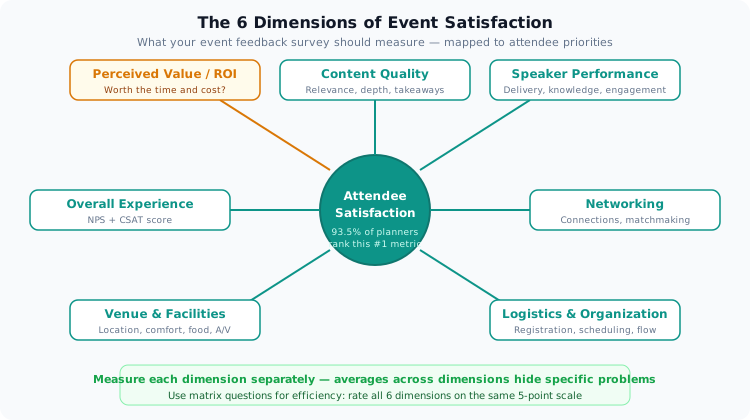
The shift is significant. 93.5% of event planners now rank attendee satisfaction as their most important ROI metric, and 76.1% consider post-event surveys a critical measurement tool.
The business case is clear: timely post-event evaluations can improve event ROI by up to 45%. Not because the survey itself creates value, but because it surfaces the specific problems and successes that would otherwise remain invisible.
Without structured feedback, organizers tend to:
- Repeat the same format without knowing what worked
- Over-invest in aspects attendees don’t value (expensive venues, elaborate catering)
- Under-invest in what actually drives satisfaction (content quality, networking time)
- Lose attendees who quietly decide not to return
A well-designed 5-minute survey prevents all of this.
When to send your post-event survey
Timing is the single biggest controllable factor in event survey response rates. Research consistently shows that speed matters more than perfection.
The 24-hour rule
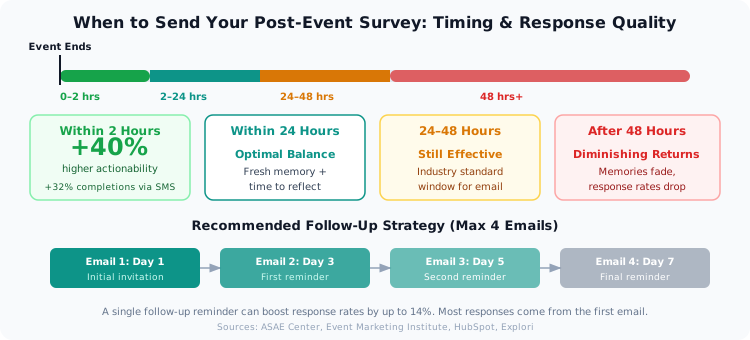
The consensus across event research is clear: send your survey within 24 hours of the event ending. This captures feedback while the experience is fresh — attendees remember specific sessions, interactions, and logistics details that fade quickly.
Key findings:
- Feedback collected within 2 hours scores 40% higher on actionability than delayed surveys (Event Marketing Institute, 2024)
- Surveys sent via SMS within 2 hours of event close get 32% more completions
- Sending within 24 hours vs. 7 days after produces substantially better response rates because attendees remember why you’re reaching out
The cost of waiting
Every day you delay, you lose two things: response rate and data quality. The further from the event, the more attendees reconstruct memories rather than report them — and reconstructed memories are less reliable.
The further away from your event you collect feedback, the more you cannibalize your response rate. After 48 hours, you’re competing with the next thing in your attendees’ lives.
Follow-up strategy
Research suggests a maximum of four total emails:
- Day 1 — Initial invitation (captures 60–70% of responses)
- Day 3 — First reminder (captures 15–20% more)
- Day 5 — Second reminder (captures 5–10% more)
- Day 7 — Final reminder (diminishing returns)
A single follow-up reminder alone can boost response rates by up to 14%. Beyond the third email, returns are minimal.
Best days and times
If your event ends on a weekend and you need to wait: Mondays consistently outperform other weekdays by 10% in survey response rates. Avoid Fridays — they see 13% fewer responses than the weekly average. Aim for mornings or late afternoons.
How to maximize response rates
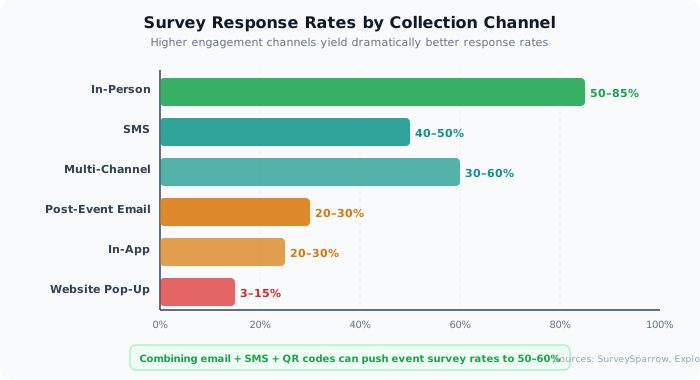
Event survey response rates vary dramatically depending on how and where you collect feedback.
Channel benchmarks
The collection method matters more than most organizers realize:
| Channel | Response Rate |
|---|---|
| In-person (on-site kiosks, QR codes) | 50–85% |
| SMS | 40–50% |
| Multi-channel (email + SMS + QR) | 30–60% |
| Post-event email | 20–30% |
| In-app notifications | 20–30% |
| Website pop-ups | 3–15% |
The single most effective strategy: combine channels. Using email + SMS + QR codes together can push event survey response rates to 50–60%, compared to email-only surveys that typically cap at 30%.
What “good” looks like
For post-event surveys specifically:
- 20–30% is a solid response rate for large conferences
- 10–20% is typical for corporate events and trade shows
- 30%+ is achievable with engaged audiences, timely outreach, and multi-channel distribution
Techniques that move the needle
Keep it short. Response rates drop by 17% when surveys exceed 12 questions or take longer than 5 minutes. Surveys over 12 minutes see 3x more dropouts than those under 5 minutes.
Personalize the invitation. Respondents who see their name in a survey respond faster and provide more reliable answers. Reference specific sessions they attended.
Optimize for mobile. Without mobile optimization, 10–25% of smartphone users drop out. With optimization, breakoffs fall to 3–7%. Use single-column layouts, large tap targets (minimum 44×44 pixels), and minimize text entry.
Consider incentives carefully. Survey response rates double with monetary incentives. Even small amounts ($2–$5) boost rates by 10–20%. For events, non-monetary incentives also work: early-bird access to next event, exclusive content, or VIP upgrades.
Don’t require answers. Making every question mandatory increases abandonment. Optional questions still produce useful data — and you keep the partial responses from people who might have otherwise quit entirely.
What to measure: the 6 dimensions of event satisfaction
Most event surveys ask generic questions like “How was the event?” This produces generic, unactionable answers. Instead, measure each satisfaction dimension separately.
1. Content quality
This is consistently the top driver of attendee satisfaction. Thought-provoking keynotes, informative workshops, and relevant presentations are what attendees remember and value most.
Measure: relevance to attendee needs, depth of coverage, practical takeaways, balance of topics.
2. Speaker performance
Separate from content quality — a great topic can be undermined by poor delivery, and a skilled presenter can elevate an average topic.
Measure: knowledge and expertise, presentation style, audience engagement, ability to answer questions.
3. Networking opportunities
A primary reason professionals attend events in person. 55% of Americans report that attending events makes them feel more connected to others. The quality of networking opportunities directly impacts willingness to return.
Measure: time allocated for networking, structured matchmaking effectiveness, ease of making connections, quality of conversations.
4. Logistics and organization
Smooth coordination, accurate scheduling, and trouble-free execution elevate both satisfaction and trust. This is often the dimension that causes the most frustration when it fails — even if content and speakers are excellent.
Measure: registration process, schedule clarity, wayfinding, technology reliability, staff responsiveness.
5. Venue and facilities
The physical environment shapes the experience. Venue influences attendee engagement and memory retention — people remember how a space felt.
Measure: accessibility, comfort, food and beverage quality, audio/visual quality, temperature and lighting.
6. Perceived value / ROI
The ultimate question: was this worth my time and money? This dimension synthesizes all others into a single judgment.
Measure: overall value relative to cost, whether expectations were met, intent to attend future events.
Why separate measurement matters
Measuring each dimension independently reveals which specific areas need attention. An overall 4.0/5.0 rating tells you nothing. A breakdown showing content at 4.5, networking at 3.1, and logistics at 4.3 tells you exactly what to fix.
Use matrix questions for efficiency — let attendees rate all six dimensions on the same 5-point scale in a single question block. This produces rich segmented data without adding survey length.
NPS for events: how to use it and what the scores mean
Net Promoter Score has become a standard metric for events, but interpreting it requires event-specific benchmarks — not generic SaaS benchmarks.
The question
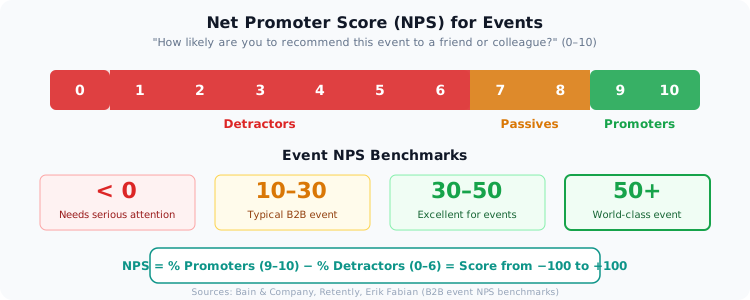
“How likely are you to recommend this event to a friend or colleague?” (0–10 scale)
- Promoters (9–10): Enthusiastic — will actively recommend and likely return
- Passives (7–8): Satisfied but not excited — vulnerable to competing events
- Detractors (0–6): Disappointed — may not return and could discourage others
NPS = % Promoters − % Detractors (score ranges from −100 to +100)
Event NPS benchmarks
General NPS benchmarks don’t apply to events. The experience is different — it’s a one-time interaction, not an ongoing relationship. Event-specific benchmarks:
| Score | Interpretation |
|---|---|
| Below 0 | Serious problems — investigate immediately |
| 10–30 | Typical for B2B events (the standard conference experience tends toward “fine, not remarkable”) |
| 30–50 | Excellent for events — you’re creating memorable experiences |
| 50+ | World-class — sustained word-of-mouth growth |
The global median NPS across all industries is 42 (2025 data from 150,000+ organizations). For events specifically, 30–50 is already excellent because events face inherent variability that SaaS products don’t — different attendees want different things from the same event.
Make NPS useful with a follow-up
The NPS number alone is a signal, not a strategy. Always pair it with:
“What is the primary reason for your score?” (open-ended)
This single follow-up question transforms NPS from a vanity metric into a diagnostic tool. Promoter responses tell you what to protect. Detractor responses tell you what to fix. Track NPS across a series of events to see whether changes are working.
CSAT vs. NPS for events
Both are useful but measure different things:
| Metric | What It Measures | Best For |
|---|---|---|
| CSAT (1–5 scale) | Satisfaction with specific aspects | Individual sessions, logistics, venue |
| NPS (0–10 scale) | Overall loyalty and likelihood to recommend | Overall event success, trend tracking |
Use CSAT for specific dimensions (content quality, networking, registration) and NPS for the overall event. They complement each other.
How to design your event survey questions
Structure: 8–10 questions, under 5 minutes
Research consistently shows that event surveys perform best when they’re short, specific, and start with the most important questions.
Recommended flow:
- NPS question — overall recommendation likelihood (0–10)
- NPS follow-up — “What is the primary reason for your score?” (open-ended)
- Satisfaction matrix — rate content, speakers, networking, logistics, venue, value (5-point scale)
- Best part — “What was the most valuable part of this event?” (open-ended)
- Improvement — “What one thing would you change for next time?” (open-ended)
- Session-specific rating — if applicable, rate individual sessions attended (5-point scale)
- Format preference — in-person, virtual, or hybrid preference for future events
- Return intent — “How likely are you to attend this event next year?” (5-point scale)
- Contact (optional) — email for follow-up or future event notifications
This structure yields: one loyalty metric (NPS), one dimensional breakdown (matrix), two qualitative insights (open-ended), and two forward-looking data points (format, return intent) — all completable in under 5 minutes.
Question design principles
Be specific, not vague. Instead of “Did you enjoy the event?” ask “How satisfied were you with the quality of keynote presentations?” Specific questions produce actionable data.
Don’t ask what you already know. If you track session attendance through your event platform, don’t ask which sessions they attended. Use that data to personalize the survey instead.
Limit open-ended questions to 2–3. They generate the richest insights but are cognitively expensive. Place them after quantitative questions so respondents can reflect on their ratings.
Use consistent scales. Mixing 5-point, 7-point, and 10-point scales within the same survey creates confusion. Pick one scale for satisfaction questions and stick with it.
Virtual and hybrid event additions
If your event had a virtual component, add targeted questions:
- “How satisfied were you with the virtual platform experience?” (5-point scale)
- “Did you encounter any technical issues?” (yes/no + optional details)
- “Did you feel equally included in Q&A, polls, and chat interactions?” (5-point scale)
These questions capture dimension-specific feedback that in-person-only surveys miss. 76% of virtual attendees participate in interactive elements like polls and chats — their experience with these tools directly impacts satisfaction.
Common mistakes that ruin event surveys
1. Sending too late
The number one killer. Surveys sent a week after the event compete with fading memories and inbox overload. By then, attendees have mentally moved on.
Fix: Send within 24 hours. Automate it so timing doesn’t depend on someone remembering.
2. Making it too long
65% of respondents tire of surveys after 7 minutes. Surveys over 12 minutes see 3x more dropouts. And the people who quit aren’t random — they tend to be busy professionals whose feedback matters most.
Fix: 8–10 questions maximum. Under 5 minutes. Test it yourself with a timer.
3. Asking leading questions
“How amazing was our keynote speaker?” presumes the answer. Leading questions produce inflated scores that feel good in reports but don’t reflect reality.
Fix: Use neutral language. “How would you rate the keynote presentation?” with a balanced scale from “Very Poor” to “Excellent.”
4. Double-barreled questions
“How satisfied were you with the venue and the speakers?” combines two different dimensions. If someone loved the speakers but disliked the venue, they can’t answer accurately.
Fix: One concept per question. Always.
5. Ignoring mobile
Most event attendees check email on their phones. If your survey has tiny buttons, matrix grids that require horizontal scrolling, or text fields that are painful to type on, mobile users will abandon it.
Fix: Mobile-first design. Single-column layout. Large tap targets. Minimize typing.
6. Collecting feedback but never acting on it
This is the most damaging long-term mistake. When attendees take time to provide feedback and see no changes at the next event, they stop responding. They also stop trusting that the organizer cares about their experience.
Fix: Close the loop. Share what you learned. Communicate what you changed. Reference feedback in your next event’s marketing.
The feedback-to-action loop
The survey is not the end product — the improvement is. Without a systematic process for turning feedback into action, even a perfectly designed survey is a waste of everyone’s time.
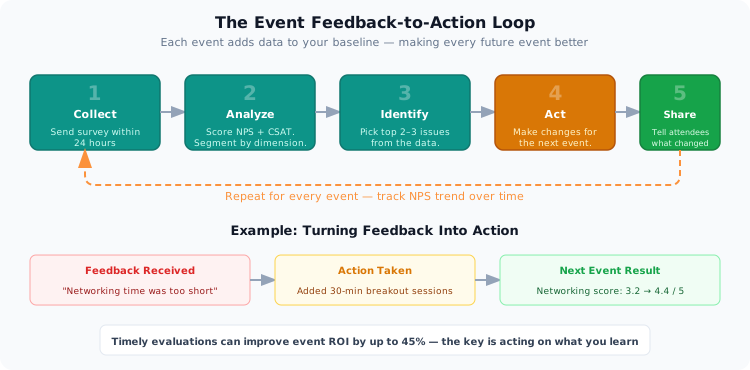
Step 1: Collect (Day 1)
Send the survey within 24 hours. Use multiple channels. Keep it under 5 minutes.
Step 2: Analyze (Week 1)
Calculate NPS and dimension-specific CSAT scores. Segment by attendee type (first-time vs. returning, VIP vs. general admission, virtual vs. in-person). Look for patterns, not just averages.
Step 3: Identify (Week 2)
Pick 2–3 specific issues that appeared consistently across responses. Don’t try to fix everything. Focus on the items with the biggest gap between expectation and experience.
Step 4: Act (Before next event)
Make concrete changes. If networking scored low, add structured breakout sessions. If content relevance was the issue, survey attendees about topics before the next event. If logistics was the problem, address the specific operational failures.
Step 5: Communicate (At next event)
Tell attendees what you changed based on their feedback: “Last year, you told us networking time was too short. This year, we added 30-minute breakout sessions after each keynote.” This does two things: it shows you listened, and it dramatically increases future survey response rates.
Track trends over time
A single survey gives you a snapshot. A series of surveys gives you a trajectory. Track NPS and dimension scores across events to measure whether changes are actually working. If you added breakout sessions and networking scores went from 3.2 to 4.4, that’s measurable proof that feedback-driven iteration works.
Each event adds data to your baseline, making your programming, sponsorship strategy, and reporting more reliable over time.
A complete event feedback survey template
Here’s a ready-to-use template for a post-event survey:
Target: All attendees, sent within 24 hours Length: 9 questions, ~4 minutes Channels: Email + SMS + QR code at venue
Q1. How likely are you to recommend this event to a friend or colleague? (0–10 NPS scale)
Q2. What is the primary reason for your score? (Open-ended)
Q3. Please rate the following aspects of this event: (Matrix, 5-point scale: Very Poor / Poor / Average / Good / Excellent)
| Dimension | Rating |
|---|---|
| Content quality and relevance | ⃝ ⃝ ⃝ ⃝ ⃝ |
| Speaker presentations | ⃝ ⃝ ⃝ ⃝ ⃝ |
| Networking opportunities | ⃝ ⃝ ⃝ ⃝ ⃝ |
| Event logistics and organization | ⃝ ⃝ ⃝ ⃝ ⃝ |
| Venue and facilities | ⃝ ⃝ ⃝ ⃝ ⃝ |
| Overall value for your time | ⃝ ⃝ ⃝ ⃝ ⃝ |
Q4. What was the most valuable part of this event? (Open-ended)
Q5. What one thing would you change to improve this event? (Open-ended)
Q6. How likely are you to attend this event next year? (5-point: Definitely not / Probably not / Unsure / Probably yes / Definitely yes)
Q7. Which format do you prefer for future events? (Multiple choice: In-person / Virtual / Hybrid / No preference)
Q8. Any additional comments? (Open-ended, optional)
Q9. Would you like to be notified about our next event? (Yes/No + email field, optional)
This template balances quantitative measurement (NPS, matrix ratings, return intent) with qualitative depth (three open-ended questions) while staying under 5 minutes.
Measuring success: what good results look like
After running your survey, here’s how to interpret the key metrics:
| Metric | Below Average | Good | Excellent |
|---|---|---|---|
| Response rate | Below 15% | 20–30% | 30%+ |
| Event NPS | Below 10 | 10–30 | 30–50+ |
| Return intent (% “Probably/Definitely yes”) | Below 50% | 60–75% | 75%+ |
| Overall satisfaction (avg on 5-point scale) | Below 3.5 | 3.5–4.2 | 4.2+ |
| Content quality score | Below 3.5 | 3.5–4.0 | 4.0+ |
Low scores aren’t failures — they’re data. A 3.1 networking score tells you exactly where to invest energy for the next event. A high NPS with low return intent suggests attendees liked this event but may not see value in a recurring commitment — which is a different problem than dissatisfaction.
The real competitive advantage
Most events don’t fail because of bad venues or boring speakers. They fail because organizers don’t systematically learn from their audiences.
The events that improve year over year — the ones that build loyal, growing audiences — share one pattern: they collect feedback consistently, analyze it honestly, act on it visibly, and close the loop with attendees.
A 5-minute survey sent within 24 hours, analyzed within a week, and acted on before the next event is worth more than a month of planning based on assumptions.
Start building your event feedback survey at SurveyReflex
References
- Bizzabo. 2026 Event Marketing Statistics, Trends, and Benchmarks.
- Samaaro. Top 15 Metrics That Matter Most in Post-Event Reports.
- ASAE Center (2024). 5 Best Practices for Creating and Sharing Post-Event Surveys.
- Explori. What Is a Good Post-Event Survey Response Rate?
- SurveySparrow. 2025 Survey Response Rate Benchmarks.
- Retently. What Is a Good Net Promoter Score? (2025 Benchmark).
- HubSpot. What’s the Ideal Survey Length?
- Edwards, P. J. et al. (2019). Effectiveness of Incentives and Follow-up on Survey Response Rates. BMC Medical Research Methodology.
- Survey Methods: Insights from the Field. Device Effects on Survey Response Quality (2020).
- Qualtrics. Net Promoter Score: The Ultimate Guide.
- Glue Up. How to Build a Post-Event Feedback Loop.
- Richards, G. et al. (2020). Event Experiences: Measurement and Meaning. Taylor & Francis.
— The SurveyReflex Team