How to Build an Employee Engagement Survey That Actually Works (Research-Backed Guide)
Employee engagement surveys are one of the most powerful tools a small business has — but only when designed correctly.
Most engagement surveys fail not because people refuse to participate, but because the survey itself is poorly designed, the results are never acted on, or the questions measure the wrong things. The result is wasted time and eroded trust.
This guide draws on decades of organizational psychology research — from Gallup’s meta-analyses covering 2.7 million employees to foundational academic work on what actually drives engagement — and translates it into a practical framework that any small business owner can use.
No HR department required. No enterprise software needed.
Why employee engagement matters for small businesses
It’s tempting to think engagement surveys are a “big company” thing. They’re not.
Gallup’s 2024 State of the Global Workplace report found that only 21% of employees globally are engaged — the second decline in 12 years. In the U.S., engagement fell to 31%, the lowest in a decade. And 70% of team engagement variance is attributable to the manager.
For small businesses, that last number is the most important. In a 10-person team, a disengaged manager doesn’t just affect one department — it affects the entire company.
The business impact is measurable. Gallup’s Q12 meta-analysis — covering 456 studies, 276 organizations, and 112,312 business units — found that top-quartile engaged teams vs. bottom-quartile teams show:
| Outcome | Difference |
|---|---|
| Profitability | 23% higher |
| Productivity | 18–20% higher |
| Turnover (high-turnover orgs) | 18–24% lower |
| Turnover (low-turnover orgs) | 43–59% lower |
| Absenteeism | 41% lower |
| Quality defects | 40–41% fewer |
| Customer ratings | 10% higher |
The global cost of disengagement is estimated at $8.9 trillion per year — 9% of global GDP.
For a small business, even modest improvements in engagement can directly impact retention, productivity, and revenue.
What “engagement” actually means (and what it doesn’t)
Employee engagement is not the same as happiness, satisfaction, or morale. These are related but distinct concepts.
The foundational definition comes from William Kahn’s 1990 study in the Academy of Management Journal — the most cited paper on the topic. Kahn defined engagement as “the harnessing of organization members’ selves to their work roles” — where people invest themselves physically, cognitively, and emotionally in their work.
Kahn identified three psychological conditions that enable engagement:
- Meaningfulness — the work feels worthwhile and valuable
- Safety — people can be themselves without fear of negative consequences
- Availability — people have the physical, emotional, and psychological resources to engage
This framework matters because it shifts the focus from “are employees happy?” to “are the conditions in place for people to fully invest in their work?”
What research says actually drives engagement
Multiple research streams converge on a consistent set of drivers. Understanding these is critical before writing a single survey question — because your questions should measure these drivers, not generic satisfaction.
The Job Demands-Resources (JD-R) Model
The dominant academic framework for understanding engagement, developed by Bakker and Demerouti. It identifies two pathways: high demands without resources lead to burnout, while high resources fuel engagement and performance.
A key finding from a meta-analysis of 55 longitudinal studies: organizational-level resources — how work is organized, designed, and managed — predict engagement much more strongly than task-level resources. Fair treatment (organizational justice) was identified as a particularly powerful driver.
Self-Determination Theory (Deci & Ryan)
Three innate psychological needs drive intrinsic motivation:
- Autonomy — acting from your own volition
- Competence — feeling effective at what you do
- Relatedness — feeling connected to others
A critical finding for small business owners: Olafsen et al. (2015) found that pay did not relate to employees’ basic need satisfaction or intrinsic motivation, but managerial autonomy support was a positive predictor of both. This means giving people meaningful input into how they work matters more than compensation alone.
Psychological Safety (Edmondson / Google’s Project Aristotle)
Google’s Project Aristotle studied 250+ team-level variables and found that psychological safety was the single most important factor behind high-performing teams. Teams with high psychological safety had lower turnover, more diverse ideas, and were rated effective 2x more often by management.
Amy Edmondson of Harvard Business School defined it as “a shared belief that the team is safe for interpersonal risk-taking.”
Recognition Frequency
Gallup’s research shows employees who receive recognition at least weekly are 5x more likely to be highly engaged. Only one in three U.S. workers strongly agree they received recognition in the past seven days. Poorly recognized employees are 2x more likely to say they’ll quit within a year.
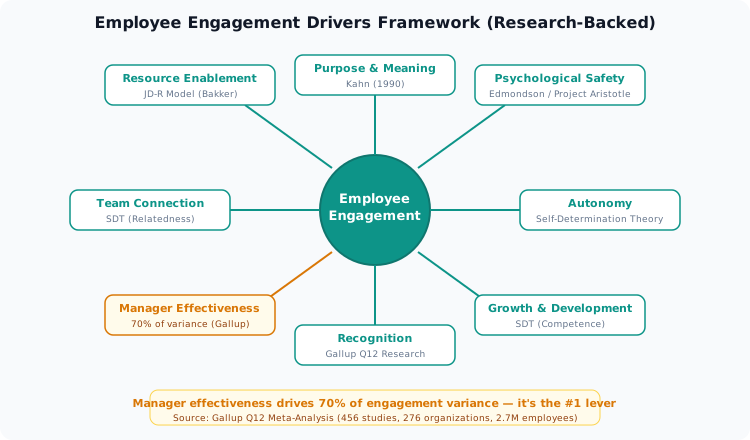
The engagement drivers your survey should measure
Based on the research above, your survey questions should map to these evidence-backed categories:
| Category | Research Basis | What It Measures |
|---|---|---|
| Purpose and meaning | Kahn (1990), JD-R Model | Whether work feels worthwhile |
| Psychological safety | Edmondson, Google Project Aristotle | Whether people can speak honestly |
| Autonomy | Self-Determination Theory | Whether people have meaningful input |
| Growth opportunities | Hackman & Oldham, SDT (competence) | Whether people can develop skills |
| Recognition | Gallup Q12 research | Whether contributions are acknowledged |
| Manager effectiveness | Gallup (70% of variance) | Whether leadership supports engagement |
| Team connection | SDT (relatedness), Kahn (safety) | Whether people feel belonging |
| Resource enablement | JD-R Model, Kahn (availability) | Whether people have what they need |
| Workload sustainability | JD-R Model (demands pathway) | Whether demands are manageable |
If your survey doesn’t cover these areas, it’s measuring the wrong things.
How to design your survey questions
Research-backed best practices for question design:
Use 5-point Likert scales
The 5-point scale (Strongly Disagree to Strongly Agree) remains the standard because it allows a neutral midpoint, produces normally distributed data, and is easy to complete. Use consistent scales throughout the survey to reduce cognitive effort.
Avoid these common question design mistakes
- Double-barreled questions — “I am motivated AND we hold people accountable” conflates two constructs. Split them.
- Leading questions — “How satisfied are you with our excellent leadership?” presumes the answer. Use neutral language.
- Acquiescence bias — If all questions are framed positively, some respondents will default to “agree.” Mix in reverse-coded items.
- Vague questions — “Do you like your job?” tells nothing actionable. Be specific about what dimension you’re measuring.
Recommended question structure (~12–15 items)
1–2 overall engagement items (including eNPS) 3–5 items on key experience dimensions (manager, team, resources) 2–3 items on current organizational priorities 1–2 items checking action on previous feedback 1 open-ended question for qualitative input
This keeps the survey completable in 10–15 minutes, which research shows is the upper bound before response quality degrades.
Sample questions mapped to research
Here are example questions for each evidence-backed category. Adapt the language to fit your company’s tone.
Purpose and Meaning (Kahn’s meaningfulness condition)
- “I understand how my work contributes to the company’s goals.”
- “My work feels meaningful and purposeful.”
Psychological Safety (Edmondson / Project Aristotle)
- “I feel safe expressing my honest opinions at work.”
- “Mistakes are treated as learning opportunities on my team.”
Autonomy (Self-Determination Theory)
- “I have meaningful input into decisions that affect my work.”
- “I have flexibility in how I approach my tasks.”
Growth and Development (SDT competence, Hackman & Oldham)
- “I have opportunities to learn and develop new skills.”
- “Someone has talked to me about my progress in the last six months.”
Recognition (Gallup research)
- “I have received meaningful recognition for my work in the last two weeks.”
- “My contributions are valued by my team.”
Manager Effectiveness (Gallup — 70% of engagement variance)
- “My manager provides clear expectations for my work.”
- “My manager cares about me as a person, not just an employee.”
Team Connection (SDT relatedness)
- “I feel a sense of belonging on my team.”
- “My coworkers are committed to doing quality work.”
Resource Enablement (JD-R Model, Kahn’s availability)
- “I have the tools, materials, and information I need to do my job well.”
- “Processes and systems support rather than hinder my work.”
Workload Sustainability (JD-R demands pathway)
- “My workload is manageable on a consistent basis.”
- “I am able to maintain a healthy balance between work and personal life.”
eNPS (Employee Net Promoter Score)
- “On a scale of 0–10, how likely are you to recommend this company as a great place to work?”
Open-Ended
- “What is one thing we could change that would most improve your experience here?”
How often to run engagement surveys
Research and practitioner consensus point to a layered approach:
Annual comprehensive survey (25–30 questions) For deep diagnostics and year-over-year benchmarking. This is your full engagement health check.
Quarterly pulse surveys (5–10 questions) The most popular cadence because it aligns with business cycles and leaves time to review and act. Track 2–3 rotating focus areas.
Monthly micro-pulses (1–3 questions) For real-time sentiment on specific topics. Quick to complete, useful for spotting emerging issues.
The biggest driver of survey fatigue is not frequency — it’s lack of follow-through. Employees don’t get tired of being asked. They get tired of nothing changing.
Anonymity is non-negotiable
Research is clear: 75% of employees are more truthful when assured of anonymity. Without anonymity, employees tell you what they think you want to hear — which makes your data useless.
For small businesses, anonymity requires extra care:
- Set minimum thresholds — don’t show results for groups smaller than 5 people
- Limit demographic questions — in a 15-person company, combining job title + tenure + location can identify individuals
- Use a third-party tool — responses that pass through management lose credibility
- Communicate anonymity clearly — explain it before, during, and after the survey
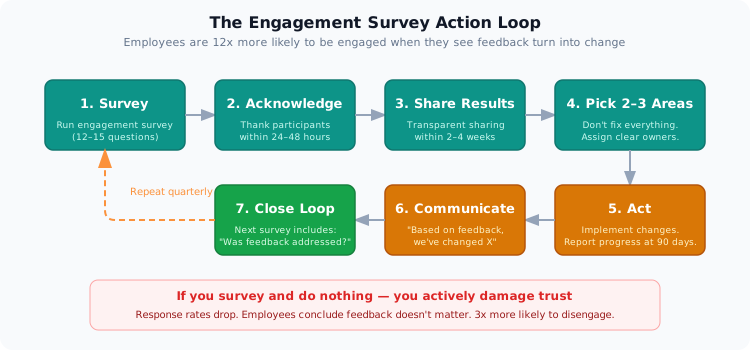
The most important step: acting on results
This is where most engagement surveys fail — and it’s the single biggest factor in whether your next survey succeeds.
Research shows employees are 12x more likely to be highly engaged when they see feedback turn into meaningful change. Conversely, employees are 3x more likely to disengage when leaders fail to acknowledge results.
A practical action framework for small businesses:
- Share results within 2–4 weeks of survey close — transparency builds trust
- Acknowledge the survey within 24–48 hours — thank people for participating
- Pick 2–3 focus areas — don’t try to fix everything at once
- Assign clear ownership — “improving recognition” needs a specific person and timeline
- Communicate progress continuously — “Based on your feedback, we’ve changed X”
- Close the loop in the next survey — include 1–2 questions asking whether previous feedback was addressed
If you run a survey and do nothing with it, you’ve actively damaged trust. Response rates will drop the following year, and employees will conclude that feedback doesn’t matter.
Common mistakes to avoid
Averaging masks problems
One team at 4.5/5 and another at 1.5/5 produces an average of 3.0 — which completely hides both a serious problem and a best practice. Always segment results by team or role, even in small organizations.
Treating it as an annual checkbox
A single annual snapshot misses fluctuations, seasonal patterns, and emerging issues. Combine annual diagnostics with regular pulse surveys.
Generic questions without clear objectives
Before writing questions, define: What decisions will this data inform? If you can’t answer that, the survey isn’t ready.
Ignoring the manager’s role
Gallup’s research shows 70% of team engagement variance is attributable to the manager. If your survey doesn’t include questions about management effectiveness, you’re missing the largest lever.
Not accounting for accessibility
Non-native English speakers or employees with disabilities may face challenges. Keep language simple, avoid jargon, and consider offering the survey in multiple formats.
Putting it all together — a small business survey blueprint
For a small business running its first engagement survey, here’s a practical starting point:
Format: 12 Likert-scale items + 1 eNPS + 1 open-ended = ~15 minutes
Question flow:
- Overall engagement (eNPS)
- Purpose and meaning (2 items)
- Manager effectiveness (2 items)
- Psychological safety (1 item)
- Autonomy and growth (2 items)
- Recognition (1 item)
- Resources and workload (2 items)
- Team connection (2 items)
- Open-ended: “What is one thing we could change?”
Frequency: Start with one comprehensive survey, then move to quarterly pulses on rotating focus areas.
Follow-up: Share results within 2 weeks. Pick 2 areas. Assign owners. Report progress in 90 days.
The goal isn’t a perfect score. It’s an honest baseline and a visible commitment to improvement.
Start building your engagement survey at SurveyReflex
References
- Kahn, W. A. (1990). Psychological Conditions of Personal Engagement and Disengagement at Work. Academy of Management Journal.
- Gallup. Q12 Employee Engagement Survey.
- Gallup. Employee Engagement Drives Growth (Q12 Meta-Analysis Summary).
- Gallup (2024). State of the Global Workplace Report.
- Gallup. Employee Recognition: Low Cost, High Impact.
- Schaufeli, W. B. et al. (2006). The Measurement of Work Engagement with a Short Questionnaire (UWES-9). SAGE Journals.
- Deci, E. L., Olafsen, A. H., & Ryan, R. M. (2017). Self-Determination Theory in Work Organizations. Annual Review of Organizational Psychology.
- Edmondson, A. C. Four Steps to Build Psychological Safety. Harvard Business School.
- Google’s Project Aristotle. Psychological Safety and Team Performance.
- Mazzetti, G. et al. (2020). Drivers of Work Engagement: A Meta-Analysis of Longitudinal Studies. Work & Stress.
- Job Demands-Resources Model and Performance. Frontiers in Psychology (2023).
- Harter, J. K., Schmidt, F. L., & Hayes, T. L. (2002). Business-Unit-Level Relationship Between Employee Engagement and Business Outcomes. Journal of Applied Psychology.
- Harvard Business Review (2019). Where Measuring Engagement Goes Wrong.
- Harvard Business Review (2024). 3 Key Metrics That Employee Engagement Surveys Miss.
- SHRM. Managing Employee Surveys Toolkit.
- SHRM. Carefully Craft the Employee Engagement Survey.
— The SurveyReflex Team