
Correlation, Causation, and the Survey Trap
Surveys are powerful at revealing patterns.
You compare two variables and notice:
- Users who rate onboarding highly also renew more often.
- Customers who say “price is too high” churn more.
- Respondents who use Feature A report higher satisfaction.
The temptation is immediate:
“Onboarding quality causes retention.” “Price is causing churn.” “Feature A drives satisfaction.”
This is the survey trap.
Surveys are excellent at detecting correlation — relationships between variables. They are rarely capable of proving causation — that one variable directly produces change in another.
And yet many business decisions treat survey findings as causal evidence.
Correlation is about movement together
When two variables move together, we say they are correlated.
If: High satisfaction ↔ High retention
There is association.
But correlation alone does not answer:
- Does satisfaction cause retention?
- Does retention increase satisfaction?
- Or is a third factor influencing both?
This distinction is fundamental in statistics and research design. The American Statistical Association has explicitly warned against overinterpreting associations as causal relationships, especially in observational data.
Survey data is observational by nature. Respondents self-report attitudes and experiences at one point in time. That structure makes causal inference difficult.
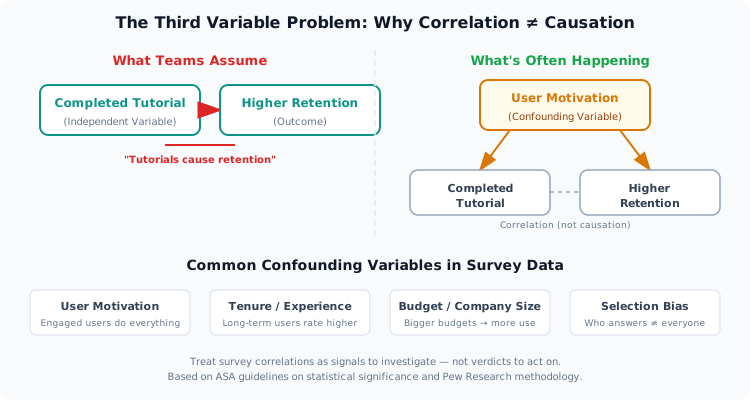
The third variable problem
One of the most common errors is ignoring hidden variables.
Suppose your survey shows:
Users who completed onboarding tutorials are 40% more likely to renew.
It feels obvious: “The tutorial increases retention.”
But consider alternative explanations:
- More motivated users are both more likely to complete tutorials and to renew.
- Long-term users are more familiar with the product and therefore rate tutorials more positively.
- Users with higher budgets are more likely to engage deeply and renew.
In each case, the correlation exists — but the cause may not be the tutorial itself.
This is known as a confounding variable problem. It is a well-documented challenge in observational research.
Pew Research frequently emphasizes that surveys describe relationships but do not establish causality unless supported by experimental design.
Cross-sectional surveys are especially limited
Most product and customer surveys are cross-sectional — meaning they collect responses at one point in time.
This design cannot determine temporal order.
For example:
High satisfaction correlates with high feature usage.
Which came first?
- Did usage increase satisfaction?
- Or did satisfied users explore more features?
Without longitudinal data or experimental manipulation, you cannot confidently determine direction.
Survey research textbooks consistently warn that causal inference requires:
- Controlled experiments,
- Longitudinal data,
- Or quasi-experimental designs.
Surveys alone rarely meet those standards.
The danger of post-hoc storytelling
Another subtle trap occurs after results are collected.
Teams look at correlations and construct narratives that “make sense.”
Example:
“Customers who selected ‘very easy to use’ are 3x more likely to upgrade.”
It sounds logical: Ease drives upgrade.
But post-hoc narratives can be misleading because humans are excellent at explaining patterns after seeing them — even when patterns are coincidental.
This phenomenon is related to confirmation bias and hindsight bias, both extensively studied in cognitive psychology.
The risk increases when:
- Many variables are compared,
- Multiple subgroup analyses are run,
- Or only statistically significant findings are highlighted.
With enough comparisons, some correlations will appear by chance.
Statistical significance is not causal proof
Even when a survey reports:
“p < 0.05”
That does not imply causation.
The American Statistical Association’s statement on p-values explicitly cautions against interpreting statistical significance as proof of a meaningful or causal effect.
Statistical significance indicates that an observed relationship is unlikely to be random under certain assumptions.
It does not prove:
- Direction of effect,
- Mechanism,
- Or absence of confounders.
In survey data, significant correlation often means: “This relationship is consistent in this dataset.”
It does not mean: “This variable caused the outcome.”
When surveys can support causal reasoning
While surveys alone cannot prove causation, they can contribute to causal understanding when:
- Combined with experiments (A/B testing).
- Collected longitudinally over time.
- Used to generate hypotheses, not final conclusions.
- Designed to measure pre- and post-intervention change.
For example:
If a product redesign occurs, And satisfaction increases afterward, And retention increases afterward, And experimental testing supports it,
Then survey data becomes part of a broader causal story.
But surveys should rarely be the sole evidence for causal claims.
The practical business risk
Confusing correlation with causation can lead to:
- Overinvesting in features that correlate with success but do not drive it.
- Eliminating elements that correlate negatively but are not causal.
- Misdiagnosing churn drivers.
- Building strategy around spurious associations.
The more data you collect, the easier it becomes to find impressive correlations.
That does not make them actionable.
A disciplined approach to survey correlations
When you discover a strong relationship in survey data, ask:
- Could a third variable explain this?
- Does temporal order support this interpretation?
- Is there behavioral data that confirms this?
- Would an experiment test this claim?
- How large is the effect size — not just statistical significance?
Treat correlations as signals — not verdicts.
The deeper insight
Surveys are descriptive tools.
They help answer:
- What people report.
- How attitudes cluster.
- Which experiences are associated.
They are not inherently explanatory tools.
When teams treat descriptive data as causal proof, they elevate surveys beyond what they can reliably deliver.
Intellectual discipline requires respecting that boundary.
A practical exercise
Take your last survey and identify one strong correlation.
Now write three alternative explanations for it.
If you can produce plausible alternatives easily, you should hesitate before acting as if the relationship is causal.
Better decisions come not from more data — but from more careful interpretation.
References
- American Statistical Association (2016). Statement on Statistical Significance and P-Values.
- Pew Research Center. U.S. Survey Research Methods Overview.
- Groves, R. M., et al. Survey Methodology. (Foundational text on survey inference and limits of observational data.)
— The SurveyReflex Team