
How AI Is Changing Survey Design (And Why Most Tools Are Behind)
Every survey starts with the same problem: someone needs answers, and they have to figure out the right questions.
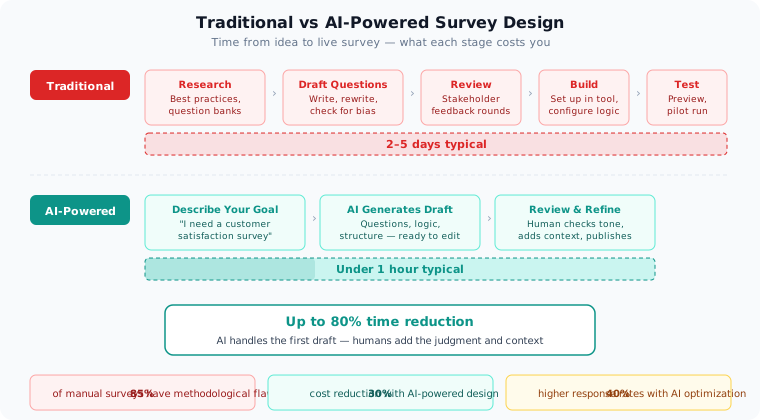
Traditionally, that process is slow. You research best practices. You draft questions, check for bias, rewrite, share with stakeholders, get feedback, revise, build the survey in a tool, test it, then launch. A well-designed survey can take two to five days from idea to live link — and that’s if you know what you’re doing. If you don’t, the result is often a survey riddled with leading questions, double-barreled phrasing, and unclear scales that produce data nobody can trust.
AI is changing this. Not in the vague, hand-wavy way that marketing copy suggests, but in specific, measurable ways that affect how surveys are created, how questions are evaluated, and how responses are analyzed. The shift is already underway: 56% of researchers used AI for qualitative analysis in 2024, up from 20% just one year earlier.
But here’s the problem. Most survey tools that claim to be “AI-powered” are not. They’ve relabeled template libraries, added keyword matching, or bolted on basic reporting dashboards and called it artificial intelligence. The gap between genuine AI capabilities and what most platforms actually deliver is wide — and it costs teams time, money, and data quality.
This post covers what AI can genuinely do for survey design today, where the hype outpaces reality, and what a useful human-AI workflow actually looks like.
The cost of designing surveys the old way
The traditional survey design process is a bottleneck that most teams accept as normal.
A quality improvement study examining institutional surveys found that only 15% scored as high quality — meaning 85% had significant methodological problems, including leading questions, ambiguous phrasing, and flawed response scales. These aren’t edge cases. They’re the norm.
The time cost compounds the quality problem. Data professionals spend roughly 80% of their time on data preparation — collecting, cleaning, organizing — leaving only 20% for the analysis and strategy that actually drives decisions. For survey-specific work, the manual design-to-launch cycle typically runs two to five days for a single survey.
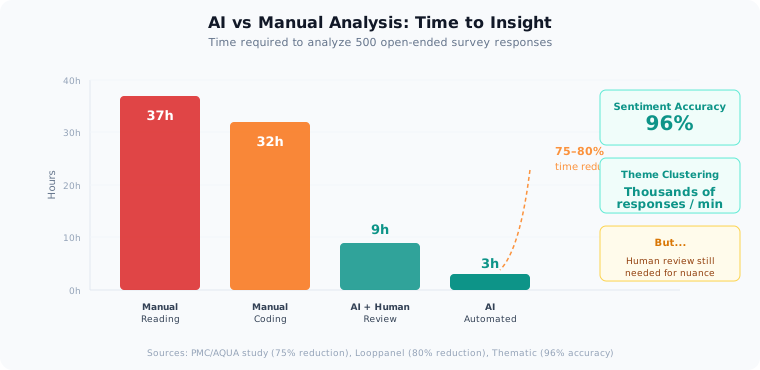
Then there’s the analysis bottleneck. When open-ended questions generate hundreds or thousands of text responses, manual coding becomes the limiting factor. A researcher reading, categorizing, and synthesizing 500 open-ended responses can spend 30 to 40 hours on a task that AI can complete in a fraction of the time.
These aren’t abstract problems. Every hour spent on manual drafting and analysis is an hour not spent acting on insights. And when survey quality is poor to begin with, the analysis effort is wasted on data that was never reliable.
What AI actually does for survey design
AI’s contribution to survey design falls into three categories: creation, quality control, and analysis. Each one addresses a specific bottleneck in the traditional workflow.
1. Survey creation from a goal description
The most immediately useful AI capability is generating survey drafts from plain-text descriptions. Instead of starting from a blank page or a generic template, you describe what you want to learn — “I need to measure customer satisfaction after onboarding” — and AI generates a structured set of questions with appropriate response types and logic.
This isn’t template matching. It’s generative: the AI produces questions tailored to your specific context, audience, and research goal. A 2025 study in the Journal of Engineering Education found that AI-generated survey questions were contextually relevant and adaptable, though they occasionally produced redundant phrasing that benefits from human editing.
The practical impact is significant. Grand View Research found that AI-powered survey tools can lead to a 30% reduction in survey costs and a 40% increase in response rates — partly because better-designed surveys get better completion rates.
2. Question quality and bias detection
AI can evaluate individual questions for problems that human reviewers frequently miss:
- Leading questions that nudge respondents toward a particular answer
- Double-barreled questions that ask about two things at once
- Loaded language that introduces emotional bias
- Ambiguous phrasing that different respondents interpret differently
- Acquiescence bias from agree/disagree scales
This matters because these flaws are common and costly. Survey methodologists have tools like QUAID (Question Understanding Aid) that help improve question comprehensibility, but most survey platforms offer nothing beyond spell-check.
AI tools can now flag these issues automatically and suggest neutral alternatives — delivering bias-free surveys up to 10x faster than manual review cycles.
3. Response analysis at scale
This is where AI creates the largest time savings. Traditional open-ended response analysis requires manual reading, coding, and categorization. AI handles this through:
- Sentiment analysis — classifying responses as positive, negative, or neutral with documented accuracy rates reaching 96% in research-grade implementations
- Theme extraction — automatically clustering responses into meaningful categories (recognizing that “shipping delay,” “package was late,” and “delivery took too long” all belong under “shipping issues”)
- Summarization — distilling thousands of responses into actionable key findings
The time savings are dramatic. Studies using automated qualitative analysis tools report a 75-80% reduction in analysis time while maintaining research quality.
The AI-washing problem in survey tools
Here’s where the industry gets uncomfortable.
AI-washing — misleading claims about AI usage in products — has become pervasive enough that regulators are paying attention. In March 2024, the SEC charged two investment advisers with $400,000 in penalties for false AI claims. In August 2025, the FTC filed a complaint against Air AI for advertising capabilities that didn’t work as promised.
Survey tools are no exception to this pattern.
What most platforms call “AI features” typically includes:
- Pre-built template libraries labeled as “AI-generated surveys”
- Keyword matching to recommend a template from their library
- Basic charting presented as “AI analytics”
- Best-practices tips in a sidebar, branded as “AI suggestions”
None of these are artificial intelligence. They’re rule-based automation at best, and static content at worst.
McKinsey’s 2025 State of AI report puts the reality in perspective: only 8% of organizations have deployed AI at scale. Another 36% are piloting. The rest are either experimenting or haven’t started. The survey tools that genuinely use AI for generation, bias detection, and natural language analysis are a small minority.
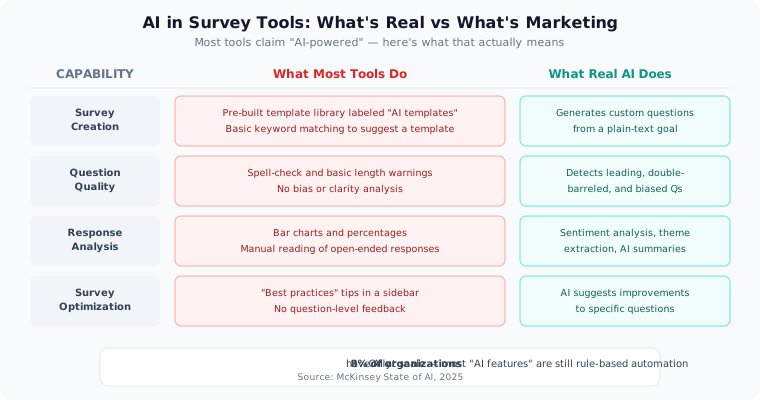
The distinction matters because teams choosing tools based on “AI-powered” marketing are often getting the same template-and-chart experience they’ve always had — just with different branding.
Adaptive surveys: AI during data collection
One of the more promising applications of AI isn’t in survey design or analysis — it’s in the survey experience itself.
Adaptive surveys use AI to modify question flow in real-time based on how respondents answer. Instead of every respondent seeing the same fixed sequence, the survey intelligently routes them through the most relevant questions.
The research supports this approach:
- Completion rates increase by 21% compared to static surveys
- Open-ended responses are 34% longer and more detailed
- Survey abandonment drops by 40%, especially among younger participants
Conversational AI takes this further. Analysis of over 5,200 free-text surveys administered by AI chatbots showed that chatbot-driven surveys elicited responses that were significantly more informative, relevant, specific, and clear than traditional form-based surveys.
This is early-stage technology — CloudResearch received a US patent for AI-driven conversational survey technology only in 2025 — but the trajectory is clear. Surveys that adapt to the respondent outperform surveys that don’t.
The adoption curve is steep — and accelerating
AI adoption in survey research isn’t gradual. It’s compounding.
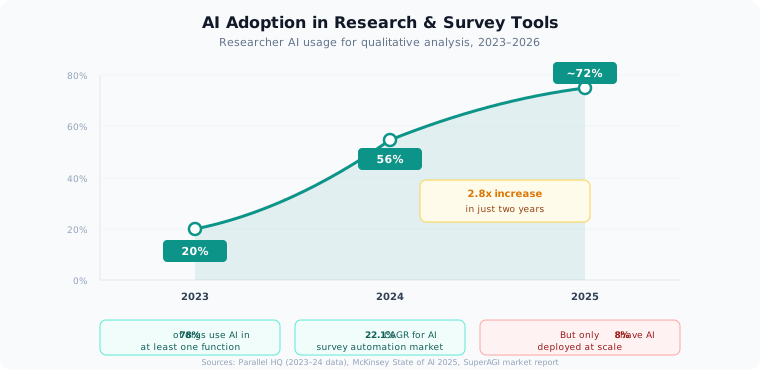
The AI-powered survey automation market is projected to grow at a CAGR of 22.1% from 2023 to 2028. More telling is the behavior change: researchers who weren’t using AI at all in 2023 are now relying on it for routine analysis tasks.
This creates a divergence. Teams that adopt AI-assisted survey workflows are producing better surveys faster and extracting insights from data that manual teams haven’t finished reading yet. The gap compounds over time: each survey cycle that benefits from AI feedback improves the next one.
Organizations implementing predictive distribution strategies — using AI to determine optimal send times, channels, and follow-up sequences — report 40-60% improvements in response rates alone.
Where AI falls short (and why humans still matter)
AI is not a survey methodologist. It’s a tool that makes survey methodologists faster and catches problems they might miss. The distinction matters.
The hallucination problem
Even the latest large language models have greater than 15% hallucination rates when analyzing provided statements, according to a benchmark evaluating 37 different LLMs. In survey design, this means AI can generate plausible-sounding questions that are subtly flawed — measuring the wrong construct, using culturally insensitive language, or creating response scales that don’t align with the research goal.
Bias reflects training data
AI-generated content reflects the biases in its training data. Studies have documented AI producing portraits of STEM professionals that were almost exclusively male, white, and older. In survey design, this manifests as questions that assume particular cultural norms, use idioms that don’t translate across populations, or default to scales and formats that work for some audiences but not others.
Context requires human judgment
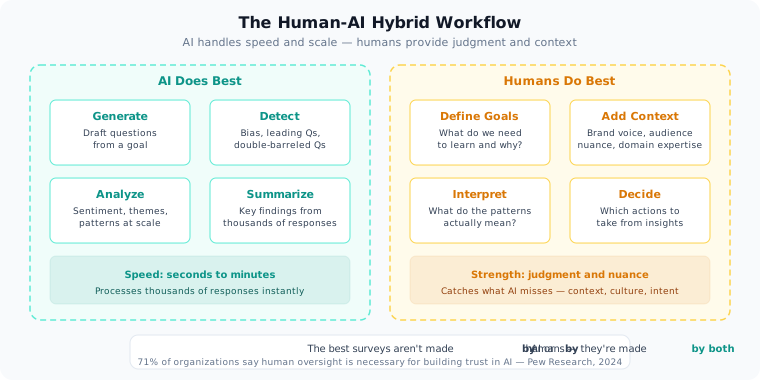
AI can detect that a question is double-barreled. It cannot tell you whether splitting it into two questions will confuse respondents in your specific industry context. It can summarize sentiment from 10,000 responses. It cannot tell you which findings your leadership team will actually act on, or how the results connect to decisions that were made six months ago.
70% of Americans are concerned that AI systems may make important decisions without sufficient human supervision. 71% of organizations implementing AI consider human oversight a necessary component for building trust.
The healthiest approach — supported by both research and practice — is hybrid: AI for speed and scale, humans for judgment and nuance.
What to look for in an AI-powered survey tool
If you’re evaluating survey platforms, here’s how to distinguish genuine AI capabilities from marketing:
Does the tool generate surveys from a goal description? Not “recommend a template” — actually generate custom questions based on what you describe. This is the difference between a search engine and a creative partner.
Does it analyze open-ended responses with NLP? Look for sentiment analysis, theme extraction, and AI-generated summaries. If the tool just shows you a word cloud or requires you to read every response manually, it doesn’t have AI analysis.
Does it suggest improvements to your specific questions? Not generic tips — specific, per-question feedback about bias, clarity, and phrasing. This requires the tool to actually evaluate your content, not just display a help article.
Does it learn from your data? The best AI implementations improve over time. They understand your audience, your industry terminology, and your survey patterns. A static template library doesn’t do this.
Tools like SurveyReflex are building genuine AI into the survey workflow — from AI-powered survey creation to AI-driven response analysis — rather than adding the label retroactively.
The bottom line
AI isn’t replacing survey design expertise. It’s making that expertise accessible to teams that don’t have a dedicated research methodologist on staff, and it’s making experienced researchers significantly faster.
The real shift is structural. Survey design used to require deep expertise at every stage: question writing, bias checking, logic building, and response analysis. AI compresses the expertise-dependent steps and amplifies the judgment-dependent ones. The result is better surveys, built faster, producing insights that arrive while they’re still actionable.
But only if the AI is real. The majority of tools claiming AI capabilities are still delivering template libraries and basic charts. The gap between genuine AI-powered survey platforms and AI-washed ones is the most important evaluation criterion for any team choosing a tool today.
The questions to ask aren’t about features. They’re about outcomes: Can this tool create a survey I couldn’t have written as quickly myself? Can it find patterns in open-ended data that I would have missed? Can it catch the bias in my questions before my respondents notice it?
If the answer is yes, the tool is genuinely using AI. If the answer is “it has a nice template gallery,” it isn’t.
References
- PMC — Quality assessment of institutional surveys: only 15% scored as high quality (Content Validity Index study)
- Parallel HQ — 56% of researchers using AI for qualitative analysis in 2024, up from 20% in 2023
- Wiley / Journal of Engineering Education — AI-generated survey questions: contextual relevance and adaptability (2025)
- SuperAGI / Grand View Research — 30% cost reduction and 40% higher response rates with AI-powered tools
- PMC / AQUA study — 75% reduction in qualitative coding time with automated tools
- Thematic — 96% sentiment analysis accuracy with human validation workflows
- McKinsey — State of AI 2025: only 8% of organizations have AI deployed at scale
- Mobius — Adaptive surveys: 21% higher completion, 34% longer open-ended responses, 40% less abandonment
- OpenResearch — 5,200+ AI chatbot-administered surveys: more informative, relevant, specific responses
- arXiv — LLM hallucination benchmark: >15% hallucination rates across 37 models
- SEC — $400,000 penalties for false AI claims by investment advisers (March 2024)
- Polling.com — Predictive distribution strategies: 40-60% improvement in response rates
Try SurveyReflex — AI-powered survey creation and analysis, pay only when you publish.
— The SurveyReflex Team